|
Quality Standards: Standards are documented
agreements containing technical specifications or other precise
criteria to be used consistently as rules, guidelines, or definitions
of characteristics, to ensure that materials, products, processes
and services are fit for their purpose. International Standards thus contribute to making life simpler, and to increasing the reliability and effectiveness of the goods and services we use.
- Worldwide progress in trade liberalization International standardisation began
in the electromechanical field in 1906 The International Organization for Standardization (ISO) is a worldwide federation of national standards bodies from some 130 countries, one from each country. ISO is a non-governmental organization established in 1947. The mission of ISO is to promote the development of standardization and related activities in the world with a view to facilitating the international exchange of goods and services, and to developing cooperation in the spheres of intellectual, scientific, technological and economic activity. ISO's work results in international agreements which are published as International Standards.
The scope of ISO is not limited to any particular branch; it covers all technical fields except electrical and electronic engineering, which is the responsibility of IEC. The work in the field of information technology is carried out by a joint ISO/IEC technical committee.
ISO 9000:
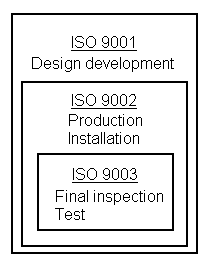
Most widely known quality standards are ISO 9000 series of standards. They help organizations establish a foundation for a comprehensive quality management program. ISO standards for the International Organization for Standardization which consist of nearly 100 member countries. A series of five international standards: ISO 9000-1, ISO 9001, ISO 9002, ISO 9003, and ISO 9004-1, constitutes the core of the ISO 9000 standards.
ISO 8402 :
ISO 9000-1 :
ISO 9000-2 :
ISO 9000-3 :
ISO 9000-4 :
ISO 9001 :
ISO 9002 :
ISO 9003 :
ISO 9004-1 :
ISO 9004-2 :
ISO 9004-3 :
ISO 9004-4 :
Complying with ISO 9000 standards does not mean that every product/service meets the customers' requirements. It only shows that the quality system in use is capable of meeting them. Registration procedure:
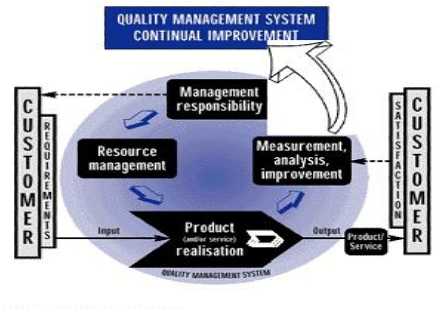
The 8 management principles, together with something called the "process model", have become the backbone of the new standart's equipments. The 20 elements that form the structure of ISO 9000:1994 series standarts are folded into a new structure with four main sections. Process Model In order to get details about each criteria, move cursor on the desired one on the graph.
For more details, visit this link. These four main sections which describe the four phases of a fundemental concept for the new standarts referred as the Process Model, which was mentioned above. This model is intended to function similar to the Plan-Do-Check-Act (PDCA) model for the continual improvement process of business management popularized by W. Edwards Deming in the 1980's.
For comparison of ISO 9000:1994 and ISO 9000:2000 revision, visit this link. Some ISO statistics around the world Certification procedure of ISO
ISO 14000 SERIES STANDARDS
The work of ISO is TC 207 encompasses the development of
a standard and guidelines in two general categories: organisation evaluation
and product and process evaluation, as follows:
Organisation Evaluation:
The EMS standard and guidelines provide the basic framework
for the management system. Environmental auditing and environmental performance
evaluation are management tools necessary for the successful implementation
of the EMS.
Product and Process Evaluation:
The emphasis in the areas of
life cycle assessment, environmental labelling and environmental aspects in
product standards is on the evaluation of product and process characteristics.
An EMS, according to the ISO
14001 International Standard, is the part of the overall management system
that includes organisational structure, planning activities, responsibilities,
practices, procedures, processes and resources, for developing, implementing,
achieving, reviewing and maintaining the environmental policy.
The basic elements of an effective
environmental management system will enable an organisation to:
Currently, it is the only standard in 14000 series that
a company can be registered to. The principal use of ISO 14001 is likely to
be third-party registration ( through a registrar ) and/or self-declaration.
It contains only those requirements of an EMS that can be audited for registration
purposes, and/or self-declaration purposes. It also contains an informative
annex that is not part of the requirements. The main body of the International
Standard is compromised of the following elements:
The environmental policy is a documented statement of commitment articulating
the organisations position on environmental protection. It outlines the intentions
of the organisation to effectively plan, manage, evaluate and improve the environmental
performance of the company. The policy must be endorsed by top management.
There are five basic steps in planning phase:
When you know what significant
impacts your organisation has, and have determined how you will address them,
the next step in the EMS process is to implement the program. This can be accomplished
through the following:
The next major step to implementing the EMS is to check and monitor
the system, and if any problems
are discovered to correct them. This
can be accomplished through the following:
The final step in the EMS process
is to review the EMS itself. This is accomplished through a top management review of the effectiveness,
suitability and adequacy of the EMS.
ISO 14004 is a guidance document, developed primarily to assist an organisation in the development and implementation of an environmental management system. It provides examples and descriptions of each element, outlines key principles and discusses how to coordinate these activities with other management systems in place in an organisation. It is intended to be used as a guidance document, not as requirement.
For more on ISO 9000 revisions and ISO 14000 see International Organisation For Standardization. Also visit ISO 9000 Translated into Plain English.
QS 9000 / TS/ISO 16949:
OHSAS 18001:OHSAS 18001 is an occupational health and safety management standard. It defines a set of occupational health and safety (OH&S) management requirements for occupational health and safety management systems (OHSMS). The purpose of OHSAS 18001 is to help organizations to manage and control their OH&S risks and to improve their OH&S performance. Since it was first published in 1999, OHSAS 18001 has rapidly become the most widely used international OH&S management standard. OHSAS 18001 applies to all types of organizations. An OHSMS is a network of interrelated elements. These elements include responsibilities, authorities, relationships, functions, activities, processes, practices, procedures, and resources. These elements are used to establish OH&S policies, plans, programs, and objectives.
TSE CERTIFICATION :The Turkish Standards Institution initiated for the conformity to standards certification with the TSE Mark System launched in 1964, with a view to inculcating among the producers the consciousness of conferment goods, protecting the life and property of the consumers facilitating the comparison and selection in purchases and avoiding unfair trade practices. Producers requesting conformity certificates from the Turkish Standards Institution obtain this privilege under a contract with the latter if the examination of the production facilities and products indicates that their practices justify the grantal of this right. Areas of Certification
Copyright © 2008 by the METU. All rights reserved. |
||||||||||||||||||||||||||||||||||||||
 WHAT ARE
STANDARDS?
WHAT ARE
STANDARDS?

 ISO 9000 underwent a minor update in 1994 and faced with a major structural revision in 2000.
 ISO 9000: Fundamentals and vocabulary
 ISO 9001: Requirements
 ISO 9004: Guidance for performance improvement